In obstructive sleep apnoea, that question may be more important than we think.
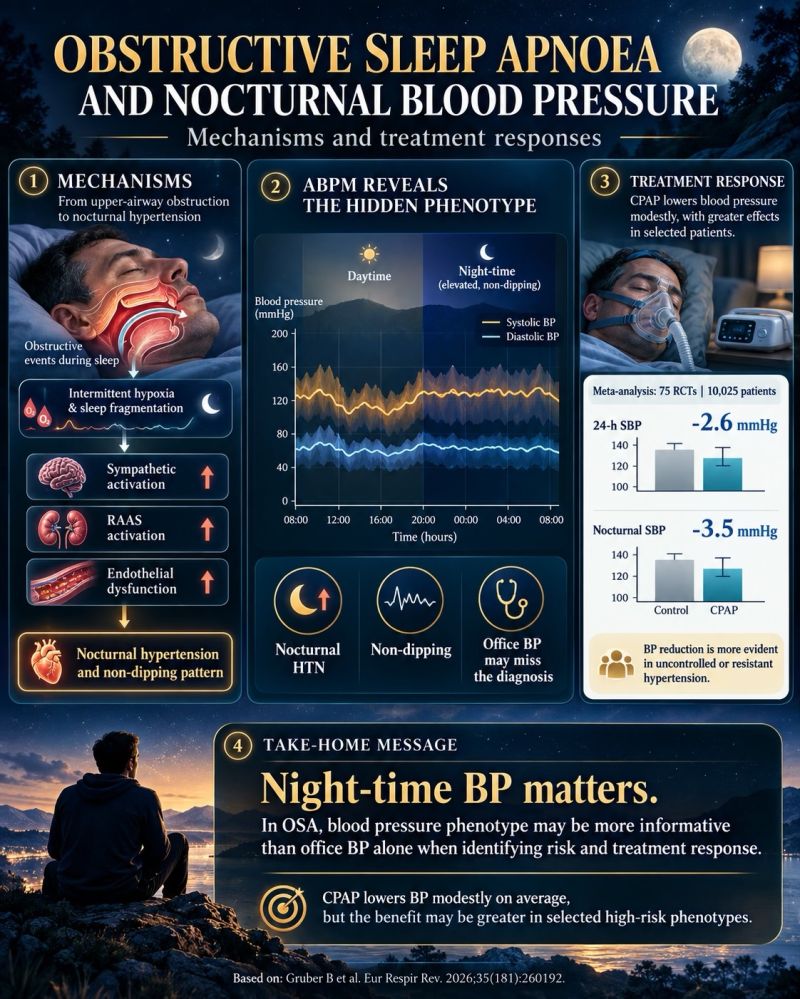
A timely review by Gruber et al. in the European Respiratory Review highlights a frequently overlooked phenotype: nocturnal hypertension and impaired dipping in patients with OSA.
Repeated upper-airway obstruction triggers intermittent hypoxaemia, arousals, sympathetic activation, RAAS stimulation and vascular dysfunction — creating the perfect setting for nocturnal BP surges and loss of the physiological night-time fall in blood pressure.
And this may remain completely hidden in the office.
The therapeutic data are equally interesting.
In the largest recent meta-analysis cited in the review:
→ 75 randomized trials
→ 10,025 participants
→ CPAP reduced 24-h SBP by approximately 2.6 mmHg
→ nocturnal SBP fell by approximately 3.5 mmHg
Modest average effects.
But averages may be hiding the real story.
The BP response to CPAP appears to be greater in patients with uncontrolled or resistant hypertension, particularly when adherence is good. Baseline blood-pressure phenotype may therefore be more informative than OSA severity alone when anticipating the antihypertensive response.
This has an important clinical implication:
Office BP does not tell us what happens while our patients sleep.
In resistant hypertension, nondipping, suspected nocturnal hypertension or OSA, ambulatory BP monitoring may reveal a phenotype that changes both risk assessment and management.
Perhaps the question should no longer be only:
“Does this patient have sleep apnoea?”
but also:
“What is their blood pressure doing at night?”
- Gruber B, Benning L, Bousraou Z, et al.
- Eur Respir Rev. 2026;35(181):260192.
- doi:10.1183/16000617.0192-2026